Is It Legal to Download Whop Course Videos? The Honest Answer
A straight answer on the legality of downloading Whop videos you've paid for — what Whop's terms actually say, where the legal grey area is, and what's clearly not okay.
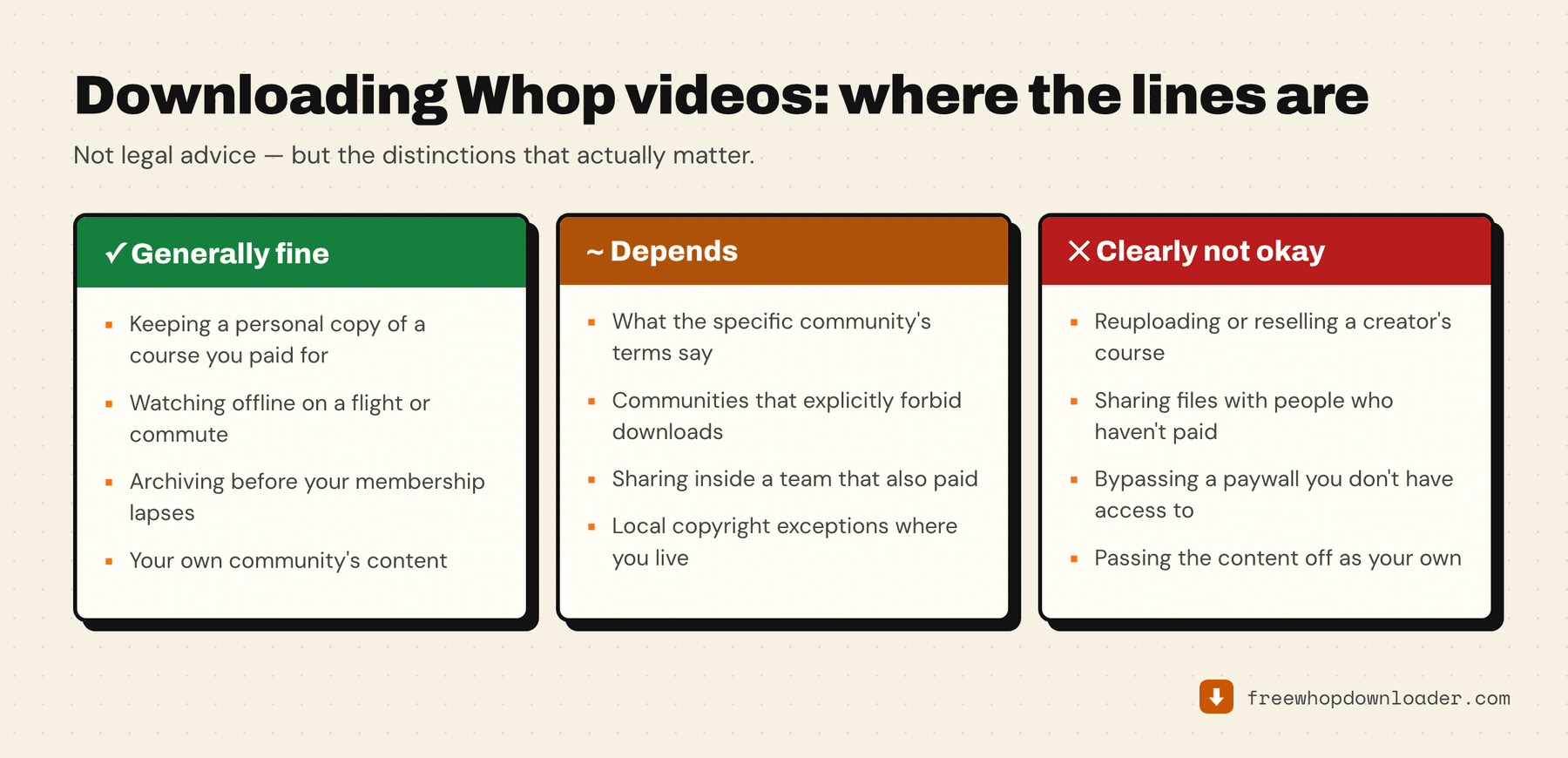
Is it legal to download Whop course videos? Before saving anything, it's reasonable to ask. The honest answer involves three layers: what Whop's terms actually say, what copyright law says about personal copies, and where the line sits between "legitimate personal use" and "something that will get you in trouble."
This isn't legal advice — I'm not your lawyer and neither is this article. But here's a clear-eyed read of the relevant rules.
What Whop's terms actually say
When you purchase access to a Whop course, you are not buying the content. You are buying a license — permission to access it on the terms the seller sets. Whop's buyer terms are explicit on this point: the seller who created the content owns all rights to it, and the license you receive is governed by that seller's own terms, layered on top of Whop's platform rules.
Whop's community guidelines prohibit:
- Selling, leaking, or disclosing proprietary data or information obtained through the service
- Infringing on third-party copyrights, trademarks, or proprietary rights
There is no explicit blanket rule in Whop's platform terms that says "downloading is prohibited." The key clause is that your use is subject to the individual seller's terms. Some creators have explicit no-recording policies. Most don't address it at all.
The personal copy argument
In the United States, the doctrine of fair use (17 U.S.C. § 107) allows some reproduction of copyrighted material without infringement, particularly for personal, non-commercial use. Courts have upheld that making a personal backup copy of something you legally purchased is generally not infringement — this is the same legal reasoning behind ripping a DVD you own to your hard drive for personal viewing.
The key factors:
- Purpose and character of the use — personal study, offline viewing = non-commercial = weighs toward fair use
- Effect on the market — a personal backup that only you watch has no effect on the creator's sales = weighs toward fair use
- You already paid for access — you're not getting something you didn't pay for
None of this is a get-out-of-jail-free card. Fair use is a defense, not a right — it's argued in court after the fact, not a pre-approval. But practically speaking, no creator has ever sued a student for making a personal backup of a course they legitimately purchased.
What is clearly not okay
The line is redistribution. Everything else is nuance; this is not:
- Sharing downloaded files with people who didn't pay for the course
- Uploading course content to YouTube, Telegram groups, file-sharing sites, or anywhere else
- Reselling access to content you downloaded
- Sharing a personal backup with a friend "just to check it out"
This applies regardless of how you obtained the file — whether you downloaded it, screen-recorded it, or took notes and reconstructed it from memory. The intellectual property belongs to the creator. The only legitimate use of a download is for your own personal offline viewing of content you already paid for.
What the downloader is designed for
The Whop Downloader is built specifically for the personal-backup use case:
- Everything processes locally. Your Whop credentials, session cookies, and video content never touch any server except Mux's CDN (which it already touches when you stream normally). Nothing is uploaded.
- It only works with content you can already watch. The extension reads streams that your authenticated Whop session can access. It cannot bypass paywalls, unlock content you haven't purchased, or access anything you don't have permission to view.
- It doesn't share your downloads anywhere. Files go to your local downloads folder.
The tool is designed to let you keep a copy of something you paid for — not to distribute it.
DRM-protected content
A creator can apply stronger content protection via DRM, which encrypts the stream in a way no extension-level tool can decrypt — the keys never leave the browser's protected playback pipeline. If that's in place, the download simply won't work, for this extension or any other. Treat it as the creator's explicit technical statement that they don't want the content downloaded, and respect it. (This is rare on standard Whop course video; the far more common cause of a failed download is something much more mundane.)
Practical reality
No Whop creator has pursued legal action against a student who downloaded a course they purchased for personal use. The enforcement risk of a personal backup is essentially zero. The enforcement risk of redistributing paid content is real — creators do issue DMCA takedowns, and platforms do ban accounts found sharing paid course material.
The thing to internalize is this: downloading for yourself is defensible. Sharing with others is not. If you're doing the former, you're in the same legal and ethical territory as ripping a CD you own. If you're doing the latter, you're pirating.
If the question behind this one is really about the tool rather than the law — what it can see, what leaves your machine — that's covered separately in is Whop Downloader safe?. And if you've decided you're comfortable, the step-by-step guide is the practical next stop.
This article is informational only and not legal advice. If you have specific legal questions about your situation, consult a qualified attorney.